Writing a Literature Review

Call me old and cranky if you like, but I have read a lot of bad literature reviews in my time.  I know I am in for a challenging read when the chapter or section is actually entitled ‘literature review’!  I was asked to provide guidance to a group of student recently, so after a quick Google which yielded loads of information but also a lot of conflicting advice I decided to reach for my keyboard.

A literature review is a description, explanation and above all else a synthesis of existing literature on a topic.  I place emphasis on the synthesis part; this is where the marks are to be found if you are a student.  So what does synthesis actually mean?  Well a synthesis is a combination of components that form a connected whole.  A pile of bricks is not a synthesis, but a house is.  Equally a chronological description of the literature is nothing more than an annotated reference list.  By contrast a useful literature review is a document which: synthesises common themes; synthesises literature either side of a debate; or scopes the unresolved issues or research gaps.

It is generally agreed that there are two type of context in which you would need to review the literature.  You may be set an assignment in which you are asked to review the literature on a subject.  Essentially this is an essay (usually with sub-headings) which demonstrates that you have found, read and understood the scientific writings on a subject.  The emphasis here is on peer-reviewed journal articles and edited chapters, not web-sources or text books, although this can vary between disciplines.  In a student context is just another assignment to be conducted within the rules set out in the assignment brief or to be clarified by your tutor.  In a professional context there are scientific review papers which aim to promote a discipline and define future research agenda within it, or simply to bring together a dispersed and obscure literature.  There is an important sub-set here which is the systematic review.  This is common in medical disciplines.  For example there may have been several different medical trials of a particular treatment over a number of years.  A systematic review finds all this data, reviews its quality, provides analysis of this data and draws out a conclusion about future practice from that data. They are designed to provide a complete, exhaustive summary of current evidence relevant to a research question.  The emphasis is on using and synthesising published data on a subject.  We are going to set them aside here because they have their own rules and methodologies.

Apart from a student assignment or a dedicated review paper the other context in which one must review the literature is at the start of a dissertation, thesis or academic paper.  This is a key part of the introduction and does not need to be sign-posted with the words ‘literature review’.  In my view it is crass to do so.  In a PhD thesis where the scope is much greater it might form a standalone ‘state of the art’ chapter, but in almost every other context it is simply part of the introduction.  The aim here is to demonstrate:

  • The rationale and context for your research question demonstrating that others think it is important and timely to study as well.  The work of offers is used to support your claim that it is interesting, important or timely.
  • That you are not simply replicating published work but contributing to a knowledge gap or refining a question that you understand. That by contributing new data, or taking a different approach, to an unresolved issue you are advancing knowledge or practice.
  • That you know what you are talking about! That you are using common methods, definitions, terms and approaches.  That your reader identifies with these terms and understands any variance you have adopted from the established norms.

So let’s look at a literature review in the context of it being simply an extended introduction.  There are two key statements or paragraphs.  The one you start with and the one you end with!  You need to start with a broad focus or ‘hook’ that attracts your reader.  It is not quite a newspaper headline like the Sun’s distasteful ‘Gotcha!’ headline of 1982, but its aims are similar to draw the reader in and make an initial point.  Why is the study important?  Why is this paper or dissertation worth reading?  What will the output be and how will it advance knowledge or practice in the area of study, or at least hopes to?

The final paragraph should loop back to the ‘hook’ and define the question, scope or aims/objectives.

“In light of the work by Tilman (2015) and Bird (2018) who collectively re-define this question and showed how it could be re-evaluated by contributing new data, it is timely to ask . . . . .  As a consequence this study aims to contribute new data to this debate by . . . . . . This aim will be realised through four objectives which are: . . . . . . .”

So we open the introduction with something broad that draws the reader in and then narrows the focus down to the research question in hand.  Now between these two points – the start and the finish – we need to place the work in context.  We need to define key terms, provide relevant background as appropriate, scope previous work in the field to help reader understand context of your approach and how your work will contribute.   This is the literature review.  The overall form of the text should be triangular; you start broad and progressively sharpen and focus the argument (or point) until you hit the reader with your aim.  And that aim should be sharp and make the reader sit up and say: “yes that makes sense, yes that will add something, wow that is well argued and justified.”  Reviewing the literature is a means to an end, not an end in itself.

So how do I go about it?

Let’s break it down into a series of steps:

Step One: Find your literature, download and/or print the papers.  Any academic search engine will do, my preference is Google Scholar.  Work hard to build up the literature you can find and use the reference lists in the papers you do find to ‘snowball’ other literature.

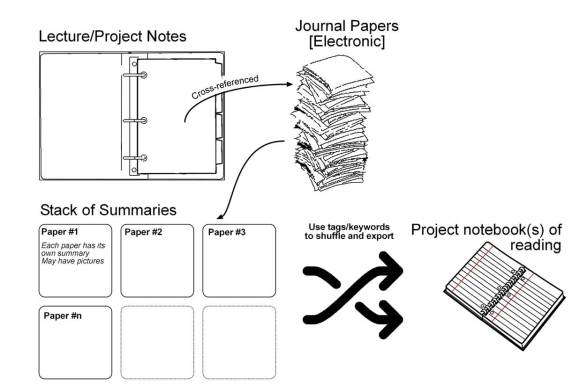
Step Two: Read critically.  By this I mean read in an engaged fashion, not just being critical of what you read.  Interrogate the article for information relevant to your question and focus only on what is relevant to your question.  Use what you read to guide and prioritise your reading.  For example if one paper keeps being cited then it is clearly important; find it and read it.  Writing one page summaries of papers can really help here (Fig. 1).

journal9

Figure 1: The one page summary of papers can really help.  You can keep them in an online note book or hard copy doesn’t matter but the idea is that you shuffle them in any order or set them out to find patterns.

Step Three: Looking for patterns.  How do the papers you read link together?  Can you group some of them as saying the same sort of thing?  What are the big themes?  There are lots of ways of doing this, but think of detectives working a case in a TV crime drama.  They usually have a wall or a board full of images, maps and items, may be with ribbons or lines drawn between key elements.  They are visualising their data looking for connections and patterns.  You can do the same.  Use a white board to jot down some key themes and list the papers under each.  Or use the floor or a large table and create piles.  Basically any way of trying to see your literature not in date order (or in the order you read it) but in terms of a new pattern.  This pattern provides the structure for review and the individual paragraphs within it.  You may find some gaps in your reading at this stage and need to go back to the earlier steps.  In facts steps One to Three often occur in parallel.

Step Four: Drafting.  Set the papers aside and turn to your keyboard.  Start by jotting down they key themes and then elaborate these into sentences and paragraphs.  Cite references from memory where you can, but don’t write from the papers themselves.  Write freely.  It is all too easy to slip into copying sentences or paragraphs consciously or unconsciously – don’t!  The reader wants to see your perspective on the literature not someone else’s.  Remember the triangle as you write – start broad and end up with a sharply phrased point at the end.  With your draft finished review it carefully looking for gaps and inconsistencies and remember that any given paper may appear several times under different themes.

Step Five: Refine and polish.  This is all about the fine detail.  Are you citing the right papers in the right places?  Have you spelt the author’s names correctly?  Are the dates correct and in the right order?  Do all the text citations correspond to a full reference in the reference list and vice versa?  Do the sentences make sense?  Does your argument or succession of paragraphs build one upon another and sharpen the focus broad to point?  Does you aim follow clearly from the succession of paragraphs?  Success is all in the detail once you have found the big themes and pulled them out.

Frequently asked questions

So what is enough?  Well if it’s an assignment then look to the brief or your tutor for clarification.  Typically they may use words like ‘review the main or key sources’ or ‘review the significant literature and developments.’  They are clearly asking you to be selective in what you include.  Alternatively if words like ‘comprehensive’ appear you have your answer.  For a dissertation you need to be pretty comprehensive is my personal view, but remember you are not describing each paper but finding the themes and citing the relevant literature to that theme.

Can I cite material cited in other papers?  The simple answer is no.  Only cite and discuss what you have read yourself.  How do you know that another person has read and interpreted it correctly?  So if I can’t get a key source?  You should try to get it or leave it out; it’s that simple.

Can I cite web sites and textbooks?  It depends a bit on the subject and level but basically not often.  There may be a defining manual or textbook for a subject especially in an area of practice and off course this may feature heavily in your review, but where ever possible go back to the primary sources.

Should I cite old papers?  Yes just because its old does not mean it is not key to a debate or seminal in the development of a subject area.  It is often harder to get older material however, many of the big publishing houses have back catalogues that stop in the mid-1990’s this does not mean it not worth pursuing.  Material that is not accessible electronically is not by default rubbish.  If a debate has lots of recent discussion then your focus will be there, but that is not always the case.

If a whole paragraph is based on one source where does the reference go?  Again there is no perfect answer but generally not at the end.  Start by saying something like:  “The work of Smith (1988) is key here.  They studied the question closely by conducting the following experiments . . . .  The key conclusion in Smith (1988) is that . . . . . The work of Smith (1988) was developed by Thompson et al. (2005) who modelled the system using . . . .”   Basically make sure the reader knows that it is Smith’s work that you are talking about by reminding them regularly.  If you only have a few sources, either because that’s all that was written or because you have not found more, then the same names will be used a lot and it is what it is.

When I have multiple citations against a sentence what order should they go in?  Date order and if they were published in the same year alphabetically, so:  “The idea that the literature view was key to the development of academia has been widely discussed (e.g., Bogs, 1967; Simons, 1988, 1989; Briggs et al., 2002; Smyth, 2002).”

Natural Philosophy

It has been said that those who see and tackle the big questions are those outside the core discipline.  Take Alfred Wegener for example, of continental drift fame, he was a meteorologist by trade yet his contribution to geology (perhaps not in his life time) was far greater.  If you live firmly within the paradigms and norms of a discipline it is hard to think heretical thoughts and to question fundamental principles.  This is one argument for the power of multidisciplinary research and education.

I got my PhD in Edinburgh way back in 1991 working with Geoffrey Boulton and David Sugden two of the leading glacial geomorphologists of their generation.  A PhD is an academic calling card and a big deal at the time, but I have never really used the title and I am still Mister Mister Bennett according the bank.  I like what my PhD stands for however, Doctor of Philosophy, and in my case natural philosophy.

Natural philosophy is rather a dated term but is one that is powerful in an age where cross-disciplinary science holds many of the answers.  It derives from the Latin philosophia naturalis and is the study of nature and the physical universe.  It is considered to be the precursor of natural science and has its origins with Aristotle.

It has been superseded by the modern concept of ‘science’ with its multiple often isolating pigeonholes such as ecology, biology, chemistry, physics, geology, geography, archaeology and so on.  Yet our world is holistic in which earth systems are linked across many disciplines.  To understand these systems one needs to take a holistic multidisciplinary view, just as Alfred Wegener did.  So I like the idea of being a natural philosopher because it stresses the value of inter-disciplinary study essential to understanding a holistic system.

My first degree is in Physical Geography (London, 1988) and I come from a line of geographers, but in truth I have worked across many disciplines in the last 26 years.  Students like to identify with a subject: we are Geographers why do we need to do chemistry or all this geology nonsense?  The truth is that to understand the natural workings of our physical environment, past, present and future we need a broad grounding in multidisciplinary science and to have the tools to communicate with other specialists.  So being a geographer is something to be proud off, but let’s not confine ourselves to just one pigeon hole!


Picture credit: By Frederik de Wit – Transferred from en.wikipedia to Commons. Scanned by Janke, Public Domain, https://commons.wikimedia.org/w/index.php?curid=2171890

Non-Linear narratives Or Why PowerPoint is bad!

Help this research by taking this anonymous quiz.

Non-linear narratives are fun, because the audience and presenter don’t know where you will end up, or if they do they don’t know by what route (Fig.1).  I used to read to my children stories that required them to make a choice of story direction and we would weave our way through a book flipping between pages as directed.  A good story tellers sitting around a camp fire never tells a story the same way twice and are always a pleasure to listen to even if you know the stories punchline.  Long live the art of storytelling.  Just because we are scientists doesn’t mean we don’t tell stories; off course we do ‘evidence-based’ stories mind, but they are still stories.

networks

Figure 1: A good storyteller can end up in the same place but will get there in a different way each time.

Microsoft PowerPoint and similar presentation tools forces linearity and once you post a set of slides students or your listeners expect you to follow that structure and to cover all the material.  PowerPoint sets a way of thinking which is not always very helpful.  In my experience it hinders lateral thinking and positive digression.  I am not the first person to think this and there is a body of work critical of PowerPoint and also defending it.

My first serious foray into ‘non-linearity’ came in 2017 when the research team, of which I am part, was awarded the chance to present at the Royal Society Summer Exhibition.  This is the premier research engagement session in the UK, with a footfall of over 11,000 ranging from dignitaries attending black tie evening sessions, to the general public and to school groups during the day.  We designed an educational experience around our theme ‘Dinosaurs to Forensics’.  I had last exhibited in 2005.  On that stand we had a large plasma screen with a linear PowerPoint running on a loop.  It was limiting when talking to a visitor, since you would often have to wait for the right slide to appear to prompt a conversation.  In 2017 we needed a teaching innovation that was non-linear.  The solution we came up with was a series of large icons on the display board each with a bar-code.  The presenter had a wireless bar-code reader with which they could zap an icon and an appropriate item or video clip would appear on the plasma screen.  In this way the presenters were able to use the icons to support different conversations or educational messages tailored to the needs of different visitors.  It was huge success.

Now I have an interest in the visual presentation of data and I was hooked on the idea of creating an alternative to PowerPoint that was non-linear, essentially bringing the Royal Society exhibit learning into the classroom.  The concept I had was like an image board similar to something you might see on Pin Interest.  That would be the hub of your lecture.  Behind each picture would be a link to YouTube, to a block of slides or to some other resource.  Essentially it would be like a window into a bank of slides or resources that you could call upon in any order; in a non-linear order.  You would not necessarily use all the slides just those that you needed on that day.  I talked at length to my collaborator in Computer Science (Professor Marcin Budka): could we create a rival to PowerPoint?  Well one day with funding we might just do that – freeware for the non-linear narratives.  However we quickly released that we could create a PowerPoint template that would actually work in a non-linear fashion.  Essentially the home slide is a grid of boxes (a bit like the grid of icon boxes you get in Windows 10), different sizes, shapes and colours.  By clicking on a box you get a slide or slides that relate to that box including any embedded media.  There is a large back arrow on the slide(s) that takes you back to the home screen.  Basically there is no forced linear narrative.

Feeling brave and keen to co-create some educational research with my students I am trying this out on my Physical Geography students in the autumn of 2018.  Wish me and them luck!

I am interested in your thoughts on presentation software and if you would like to contribute anonymously then you can do by taking the following quiz.

Time management and the eye of the storm

Now this is definitely one of those things in which the phrase ‘do as I suggest, not as I do’ applies!  We are talking about time management.  My problem is that I have too much on at any one time, rarely say no to requests to do more and get sucked in to the current project to the exclusion of the others.

There are countless websites YouTube videos with advice and self-help suggestions.  They distil in various ways to working out what the tasks are both urgent and give the greatest reward.  You are meant to prioritise them and there are various matrices to help you do this which all stem from Eisenhower Power Box.

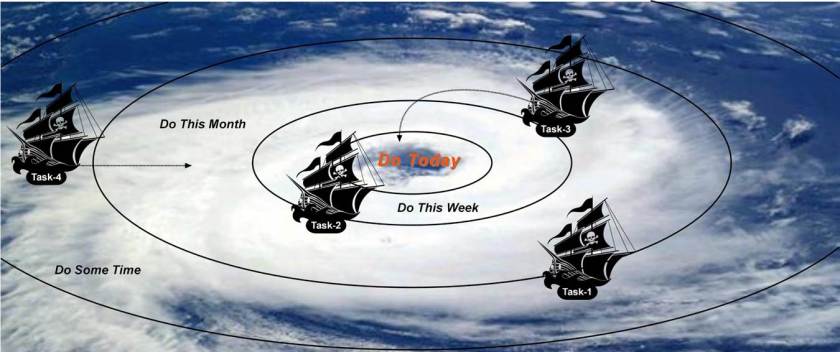
Use it if it helps.  The other method of prioritising and tracking tasks is something being a geographer I call the ‘eye of the storm’ (Fig. 1).  A colleague told me about this a while ago but called it ‘the pit’.  It is a series of concentric rings which you put on a big piece of paper.  At the centre is the stuff you should do now and is urgent, the stuff on the outside is less urgent.  When you get a task put it on a ‘post-it note’ and place it on your poster depending on its urgency.  Every few days review the live tasks and move them accordingly as they change priority.  It is the trajectory that matters tasks that are for ever circling the pit, or in my case the eye of the storm, are less important than ones that are careering with speed towards the centre.  You work calmly in the centre of the pit and keep an eye on the surrounding walls for falling rocks especially those propelled towards the centre by others!  The concept also holds for a hurricane.  Think of the eye in the centre as the calm spot where you work keeping a weather eye on the flying debris heading towards you.

eye

Figure 1:  Closer to the eye the more urgent a task is.  The key is to watch the trajectory of your tasks.  The idea stresses that your work load planning is dynamic and you should review on a daily, weekly basis and move the ships!  To use practically draw some concentric circles on a piece of paper and use post-its instead of ships!

The final bit of advice I have is to think backwards.  We tend when faced with a task to always look forward to the deadline and when it seems far off we are comforted and when it looms panic.  The alternative is to always think backwards from the deadline.  So you have an assignment due in on Monday the 26 November 2018 [and if you are a 2018 Physical Geography student you really do!].  So that is the deadline.  Thinking back from this you can work out a plan:

  • You are going to need if you can to keep clear the weekend before in case there is a last minute panic.
  • The week before the deadline you will need to write and polish the assignment. This might be the week to bring a draft to one of the drop-in sessions, although lots of people may be doing this!
  • In order to do this you will need to have worked out what to say during the week before that to give you a chance to organise the material you need and do the necessary reading.
  • The week before that you need to perhaps attend one of the drop-in help sessions to check your understanding of the task, seek guidance and test our your initial ideas.
  • How does this three week timeline fit with your other tasks and assignments? Perhaps you will need to build in an extra week or a pause while something else takes centre stage?

The idea is that by working backwards you visualise the end point and can plan more effectively.  In a crude way it’s a bit like an Olympic athlete visualising victory and working back from there.  Working forward you often end up with a greater sense of impending doom!  As the Fraser of Dad’s Army fame would say ‘we all doomed! Doomed I say!’  Better to think of the pleasure of a calm and controlled submission and work back from there and you will never be doomed!

Procrastination!

Does the early bird really catch the worm?  Well so I always thought until last year when I was preparing a lecture on time management having just read a fantastic book by Adam Grant called the Originals (2016); brilliant it is and I firmly recommend it to anyone.

In Originals Grant argues that procrastination has its place.  He makes a similar case in a New York Times article.  He cites the unpublished work of one of his students.  Students were asked to produce business plans for a new shop on campus.  Some were asked to start ASAP others after procrastinating by playing video games.   The procrastinators scored as more creative in idea generation.  His explanation was that while procrastinating they were thinking about the project subconsciously and therefore had more considered solutions.

It is not the type of answer that someone trying to encourage students to plan better and start their coursework early wants to read and it has been widely challenged in several blog posts.  Here is another.  What Grant was really talking about is perhaps better described as ‘strategic delay’ and taking time to consider and review all the options before leaping in to action. It may allow you time to gather your ideas, to reflect on the challenge, wait for more information, learn from your peers mistakes’ as they start the task.  The downside is you have less time to complete the actual task and the closer to the deadline the more pressure you may feel and the greater the impact that pressure may have on other deadlines.  So, the truth is probably something like this: planning is good and including an element of ‘reflective delay’ is potentially beneficial as long as something actually happens during the delay (i.e., you are thinking about the task).

Why not have a read of some of the post on this subject and see what you think?

Summaries of summaries: abstracts and the like

OK so this is one of those things that sounds dull but is really important professionally and also a useful tool when linked to critical reading.  Stick with it since there is a lovely bit of research to discover at the end.

So a summary is: ‘a brief statement or account of the main points of something and does not include needless details or formalities and is above all else brief!  In academic/professional circles it has many names, including: synopsis, précis, résumé, abstract, abridgement, digest, compendium, condensation, encapsulation, abbreviated version and/or case/evidence summary.

Here I am going to focus on the précis, executive summary, abstract, and lay summary.  I would also draw your attention to the use of the rhetorical triangle which is always worth remembering.

Précis

A summary for another professional or yourself and I would argue that it is a key part of critical reading.  So what are the goals?

  • Compress and clarify a lengthy passage, article, or book, while retaining important concepts, key words, and important data.
  • It is not a personal interpretation of a work or an expression of your opinion but rather, an exact miniature replica of the work itself.
  • It is about removing the superfluous so that the core of the work stands proud.
  • It should give a brief description of key terms, describe actions or methods applied and report the key results. It should finally state the next actions/steps and/or the main conclusions.
  • When finished, the précis should clearly state: (1) who did the study; (2) what the context and rationale was; (3) what was studied, argued or discussed; (4) how was it done; (5) what was learned; and (6) what the implications of the work are and what now needs doing.

While it may seem obvious it is critical that you understand the material in question and have read it all.  It is not about extracting sentences or quotes, but involves reading the piece and then setting it aside to write the précis.  You need to see and understand the whole first. Aim to fit it on no more than one page of A4, less if you can, but emit nothing from the essential argument or most pertinent data.  Do not copy a single sentence from the article! Use key words and technical phrases where there is no alternative.  When you are done review your précis to confirm that you have explained the main point of the article, identified the supporting evidence that the writer uses, and have used the same logical structure as the text.  Finally, check for clarity, coherence, and correctness.  If there is one key graph/diagram you may wish to clip it via image capture and append it to the summary.

I have written before about the use of the rhetorical triangle and there is such a thing as the Rhetorical Précis Format.  It runs something like this:

  1. In a single coherent sentence give the following:
    • Name of the author, title of the work, date in parenthesis.
    • A rhetorically accurate verb (such as “assert,” “argue,” “deny,” “refute,” “prove,” disprove,” “explain,” etc.)
    • Athat clause containing the major claim (thesis statement) of the work.
  2. In a single coherent sentence give an explanation of how the author develops and supports the major claim (thesis statement).
  3. In a single coherent sentence give a statement of the author’s purpose, followed by an “in order” phrase.
  4. In a single coherent sentence give a description of the intended audience and/or the relationship the author establishes with the audience.

Executive Summary

This is a key feature of a professional report such as you might write in professional practice.  There is a huge amount of advice on line to help write the perfect summary for a business report.  While written about stuff far from geography you still may find some useful pointers in this, just Google tips for writing executive summaries.  Whatever others may say the executive summary is not the same as an abstract.  They are different.

The basic point is that busy people want to get to the heart of the issues quickly.  They want to know whether they need to read the whole report, and know if it will it be relevant and interesting to them. People are basically lazy, so can they get the gist of the work without reading the report, or at least focus their reading on the key sections?  In writing a report you want to make sure that the key recommendations/actions are front and central and you do this via the summary.  It is not a précis, for one thing it can be longer and it expresses the main argument and conclusions of a work.  It usually has an opinion!

Here are some pointers:

  • Who is the intended audience of your executive summary?  Is it your boss, a group of colleagues, or the general public?  What content do they really need to know? When you are writing you should keep your intended audience in mind at all times and write it for them. If your audience includes your boss think: how much do they already know, and how much do you need to explain?  If your audience includes journalists, you probably need to explain everything.
  • First categorise the document by whether it needs action or is for information only. This will determine the language that you use.
  • Next, you need to identify what, when they have finished reading, are the key messages that you want your audience to have in their heads.
  • If you find yourself getting bogged down in the detail at this stage, it’s a good idea to talk to someone else about what to include.
  • The language you use needs to be formal and the normal convention is to use a three part structure: introduction, body and conclusion.
  • You need to grab you reader early so use some form of hook to draw them in is essential.
  • Finally it acceptable to use a few bullet points in this type of summary.  These should highlight three or four key points or take away messages at the end.

Academic Abstracts

Abstracts are a whole new type of summary and an academic requirement for published papers, conference presentation, dissertation and thesis.  They have various aims but essentially they are about two things.  Firstly, they aid selection by the reader or conference attendee and secondly they assist with indexing via indexing and search services.

A good abstract should always be original work, and not simply an excerpted passage from the paper.  It should also be self-contained making sense by itself, normally without references or to the actual paper. It is also in most cases word/character limited and for some journals you are required to follow a given structure.  A good abstract is hard to write and needs practice.  As with lots of similar tasks there is a lot of guidance online some of it good a lot of it bad.  So what would be essential content?

  • Reason for writing: What is the importance of the research? Why would a reader be interested in in it?
  • Problem: What problem does the work attempt to solve? What is the scope of the project? What is the main argument, thesis or claim?
  • Methodology: A brief summary of methods and approaches is normal and the types of evidence collected, or experiments complete is normally considered essential.
  • Results: It should include specific data that indicates the results of the project. Other abstracts may discuss the findings in a more general way.
  • Implications: How does this work add to the body of knowledge on the topic? Are there any practical or theoretical applications from your findings or implications for future research?

The key thing is to distinguish between ‘describing what is in the paper’ and ‘reporting what is in the paper’.  The latter is what you are aiming for.  Here are a few examples of what not to do and what to aim for:

Poor: “We will scope the research in the field.”

Better: “Research in this field falls into three areas they are: . . . .”

Poor: “We follow the methods of Robinson (1968).”

Better: “We use a total capture method in which all insects in the study area were collected. “

Poor: “We describe the results and conclusions are drawn.”

Better: “What are the results and what are the implications?”

Poor: “We describe five geological sections in detail.”

Better: “Five geological sections are examined they reveal a range of lithofacies including those associated with lacustrine, coastal and aeolian depostional settings.”

Poor: “The implications of our findings are discussed.”

Better: “The implications of our results for the nuclear industry are clear; nuclear power plants are at risk in coastal settings around the North Atlantic Margin.”

Finally as with all writing we are encouraged to be concise, precise and to say things once and only once.  Brevity is everything, who want to read a load of waffle?  You will find that almost all the advice online focuses on brevity, but is this actually what is needed?

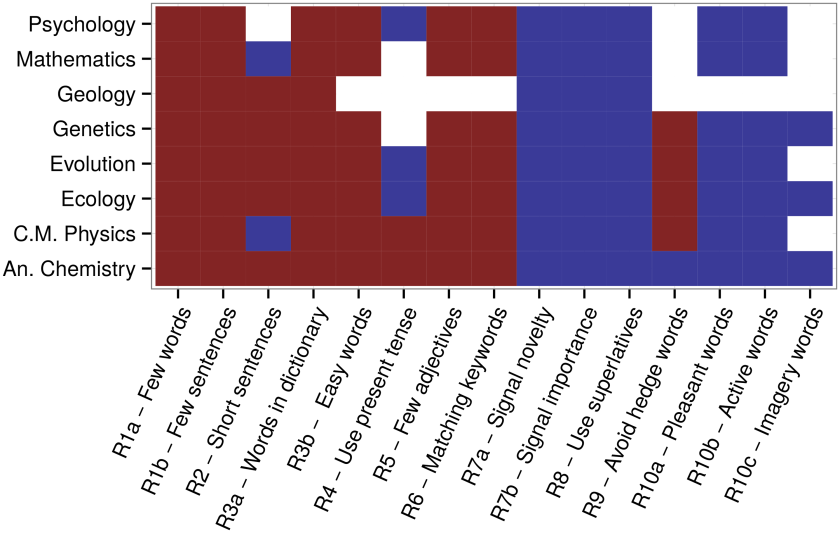
I came across this wonderful bit of research recently by Weinberger et al. (2015) around the ten simple rules for science writing.  They collected over a1 million abstracts from eight disciplines, (Ecology, Evolution, Genetics, Analytic Chemistry, Condensed Matter Physics, Geology, Mathematics, and Psychology) over 17 years and subject them to analysis.  They identified ten writing rules based on published ‘advice’ and normalised them against citations.  Figure 1 is their summary chart with rules shown vertical and disciplines horizontal.  If the cell in the table is blue it shows a significant rise in citations associated with each rule and if it’s red a decrease in citations.journal.pcbi.1004205.g001

Figure 1: The conclusions of Weinberger et al (2015)

The results are counter-intuitive!  So the advice says use fewer words and sentences (Rule R1a,b) and don’t use ‘superlatives or hype’ (Rule 8) yet both are associated with lower rates of citation.  The data actually implies that using wordy sentences with flowery language full of superlatives and writing long abstracts actually increases your change of being cited!  What is going on here?  The answer probably lies according to Weinberger et al. (2015) in the fact that academics like to read short concise abstracts but the longer they are the greater the chances of them being picked up by a search and surfaced for them to read in the first place.  Academics read what they can find easily and that is what Google Scholar and the like can surface quickly.  This dichotomy leaves the abstract writer with rather a challenge, and one that I don’t have an answer for!  Except this, if you’re a student keep it short, concise and to the point always!


How to make the most of freeware

So what is freeware?  Well put simply it is software that is free or at least purports to be free!

Free is good?  Right?  In many cases this is true, in some practice-based situations it is often preferable to use a large established and well known software system.

So for example; if you are preparing a photograph for court (or something very official) and need to label the image or adjust the brightness in a dark image then it is probably better to be on the stand saying that you did this in Photoshop than say the freewware Gimp.  Juries by and large know what Photoshop is but will have heard of it but Gimp?  For the geographers preparing material for a paper or report it doesn’t really matter.

There are different types of freeware; he is my attempt at a crude classification:

  • Community/user built versions of main stream software. For example, Gimp is a free version of Photoshop built by users.  The same is true of Inkscape and Illustrator.  The freeware is well established, does much of what the commercial software does and is actively supported by programmers and developers.  There is an element of fashion here, but the best free versions endure.
  • Community/user built specialist usually academic software. A group of academic come together to develop a piece of research software that gains momentum and widespread use.  The ‘R’ project is a great example (https://www.r-project.org).  It is a computing framework, interface and language that professionals can code in to do statistics and graphic representations.  Widely used and widely supported with lots of code libraries and tutorials.
  • Lone-operator(s) software. An individual or group of individuals who have created a piece of software for the fun of it or to overcome a particular analytical barrier.  These tend to be function/task specific and not widely supported by the community.  They can be very good and they can also be very bad!  Just think of the good and bad apps in the app store.
  • Professional software with free entry level versions. Software provided by commercial developers and companies that is offered free, with cut-down functionality or usage restrictions.  These products can be great if the bit you need is in the free part!  They are just frustrating if they aren’t.

There are two bits of freeware that could be used as substitutes for commercial packages that might really help , namely:

Adobe Photoshop >> GIMP

Adobe Illustrator >> Inkscape

Both these are broadly similar in their primary functions and are intuitively similar in many respects.

GNU Image Manipulation Program (GIMP) is a cross-platform image editor available for GNU/Linux, OS X, and Windows. It is free software and you can make changes to the source code and distribute your changes.

Inkscape is professional quality vector graphics software which runs on Windows, Mac OS X and GNU/Linux. It is used by design professionals and scientists worldwide, for creating a wide variety of graphics such as illustrations, icons, logos, diagrams, maps and web graphics. Inkscape uses the W3C open standard SVG (Scalable Vector Graphics) as its native format, and is free and open-source software.

Finally there is nothing wrong with using freeware, provided it does the job you need it to do and it does it accurately/precisely.  Sometimes however there are systems restriction within organisations which make downloading and installing such software difficult.  This does not apply to you own laptops however, just take care to only download stuff with known pedigree and from secure sites.

What follows is a list, in addition to GIMP and Inkscape that I personally think is useful to be aware off.  You may find other examples; please share what you find.  Bear in mind that my list reflects my professional interests and will be different from yours.

Useful freeware

  • As a geologist who does a lot of palaeontology and morphometric analysis I discovered PAST which is an outstanding statistical package with some neat graphic options. I use it exclusively in my own research.  It is supported by an online manual and a textbook published by Blackwell.
  • Mendeley is an excellent reference manager and is free; you can purchase additional storage however. It is excellent.
  • DigTrace is software that can be used to create 3D models from photographs. It is developed at BU and is extensively used in geological and forensic science.
  • Meshlab is an excellent 3D viewer for looking at point cloud data, basically 3D models. Rather specialised but extremely useful.
  • The ‘R’ project is a great example.  It is a computing framework, interface and language that professionals can code in to do statistics and graphic representations.
  • GeoRose is a software package for plotting directional information and is very good at what it does.
  • SedLog is a great tool for drawing stratigraphic logs.
  • GRASS GIS is a free GIS system which very popular with some academics.
  • Evernote is an excellent noting software tool; it is free at entry but requires purchases to unlock full usability.
  • Smartdraw has a range of graphic packages they are not all free and most involve payment at some point which is a bit disappointing.
  • The link that follows contains a generic list of stuff which may or may not be useful at some point in your professional career: https://gist.github.com/stared/9130888


 “There is a lot of cool freeware out there, just take a look when you need to do a specific task.”

“Use it discerningly!”

“Everyone has their favourite pieces of software; we are all different after all.  What works for one might not work for another.  ”

How to import text files into Microsoft Excel

Text, ASC or CSV files are compressed formats for data and are commonly used because they give smaller file sizes.  If you use the measurement log in Photoshop you will export a Text file.  If you are looking at palaeoclimate and archaeology for example you may wish to download climate data from something like Pangea or NOAA.   Here is how you do it.

“I don’t know this function in Excel, panic!”

“Can’t I just type the data in again?”

“It’s beyond my comfort zone!”


Importing data

In Microsoft Excel open a new sheet or workbook and navigate to the Data-tab (Fig. 1).

ex1

Figure 1: Blank Excel spread sheet.  Note the Data tab along the top

Click on the Data tab and on the left you will see an icon listed ‘From text’ click on that and a dialogue box will open (Fig. 2).  Use this to select the text file or any other similar data file.

ex2

Figure 2: Opening a text file or any other similar data file.

When you open the selected file a Wizard will open like that in Figure 3.  Use this to makes sure the data imports correctly.  In the case in Figure 3 I have checked ‘Delineated by’ and press OK.  The next window (Fig. 4) allows me to select what I think each row is delineated by.  In this case it is a space.  When I check this the preview shows me that each column will be imported into its own column.  I can now continue with the wizard and the data will be imported.

If the data won’t delineate nicely in the preview use the ‘Back’ key to navigate to the first window on the Wizard try using the ‘fixed width’ check box.  You can drag the column breaks into place using this method.

ex3

Figure 3: Data import wizard in Excel.

ex4

Figure 4: In the previous box (Fig. 3) I checked ‘delineated by’ and now it is asking me by what.  I have checked space and the preview shows me that each column will end up in its own column when imported.

Academic reading: help! Here’s some guidance that might help

So the new term is upon us and fresh faced undergraduate fill the campus.  There are some perennial questions that always come to the surface around now and many of them are about reading.  So for the benefit of my new Geography students here are a few observations which you may or may not find useful.

Listen to the introductions for University Challenge and the student will say ‘reading Biology, or reading Geology’ or at least they used to.  The point here is the word ‘reading’ – you read for your degree.  The lectures define the syllabus and provide core knowledge but above all else they scope the subject and its frontiers.  Frontiers and terrain that you are expected to explore through your own reading.

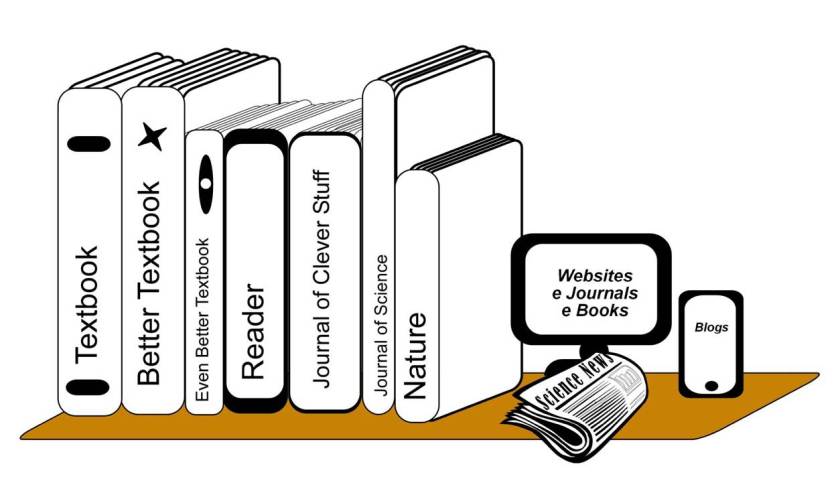
In a generation brought up with the internet and with everything online at your fingertips this is not as straight forward as it used to be 30 years ago when reading meant spending hours sitting in the basement of the library.  There is now a diversity of output (Fig. 1) where once there were simply printed journals and textbooks.  Since most academic material is now delivered online there is a blurring of boundaries.

journal2

Figure 1: Information sources.

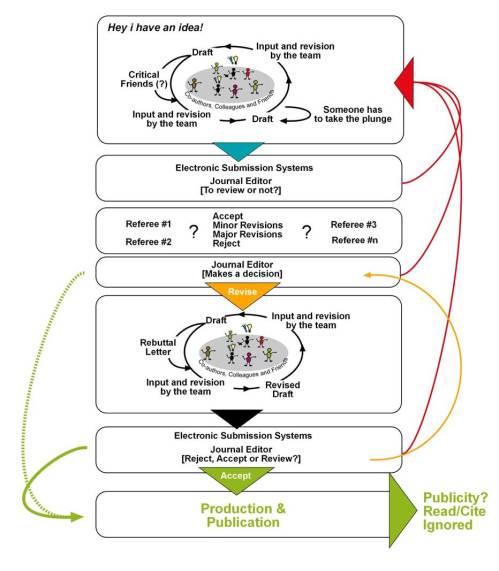
A common question is: ‘material from a website is OK right, it’s no different from an e-journal or e-book is it?’  The answer off course is no, they are worlds apart!  An e-journal has been peer reviewed, a website has not.  Anyone can post what they like, as witnessed by this site, on a website accurate or not.  Figure 2 is my take on the history of journals which can help resolve some of these questions; it is also useful to understand the process of academic publishing and the role of peer review (Fig. 3).  It is peer review that provides the safeguard against ‘fake research’ although it is not without its dark-side.

journal

Figure 2: My take on the history of the academic journal.

journal3

Figure 3: Summary of the academic peer review publishing system.  It is a bit like having your work marked by your peers; it is often a painful process!

We can look at the reading process in three steps: how do you surface material >> check its quality and reference management >> and actively read it?

Finding stuff to read

When I was a student back when the dinosaurs roamed free we were always, by the better lectures at least, given a print sheet of references to take to the library and read.  These days finding material is much easier, you can just go on line.  A lecturer may direct you to specific books and papers, but probably less so than in the past because it is so easy these days to find material.  There are specialist search engines and databases such as the Web of Knowledge and there are details and instructions on the Library web pages.  However in truth the best option is to do a simple Google Scholar search.  To be clear this is not your normal Google search engine, you will need to find it in the Google apps or search for it.  Once you have found it save it your favourites, it is in truth all you need in my opinion at least.  It surfaces academic papers and books and does so like a dream!  I use nothing else in my research unless I am on the quest for something very specialised.  Figure 4 show a typical search.  For finding the key papers fast and easily there is nothing like it and for Physical Geography it covers all the key subjects well.

schol5

Figure 4: Typical Google Scholar search.  Key words go in at the top, you can set the date range on the right and the availability of the work is listed on the right.  The double quotation marks brings out a popup with the citation.  

Quality and Reference Management

Having found your material the next thing is to think about quality.  Some good questions to ask of a source before you spend time reading are:

  • Where is the item published? Is it a textbook or research article?  Now textbooks are good in the fact that you get lots of information in one place and for developing core knowledge there is nothing better, but they are always out of date!  For some subjects this does not matter the information is timeless, but science is never static and if you want the latest information you need to seek out the original research (Fig. 5; Table 1).

journal4

Figure 5: Different lead times from research to publication.


Type of Publications Comment Quality
Journal paper/article

[Paper and e-journals]

Provided it is a reputable journal then peer reviewed is normally rigorous.  Check this Good editor and/or editorial board helps. Best source every time.  Some disciplines (e.g., archaeology) don’t always place their best stuff in journal papers – restrictions of length etc. *****
Conference volume or edited issue Peer review can be very variable and often more flex especially for the editors mates.  Editor dependent. Work is often under developed – saving the best for a paper.  More common in archaeology/anthropology. ***
Research monograph Common in archaeology were there is a lot of data to convey.  Quality depends on author and editor.  Peer review protocol more shadowy. ***
Readers and popular science The book once completed is usually reviewed by publisher – light touch.  It is also reviewed by community in published book reviews. Depends on the author, but bear in mind they are advancing a ‘thesis’ (idea) and may not be as objective as you might wish.

[Be very careful of ‘self-published’ works]

***
Textbooks The book once completed is usually reviewed by publisher – light touch.  It is also reviewed by community in published book reviews. Depends on the author, but bear in mind they are selecting information, not always representing the whole field.  Textbooks are always a few years out of date. **

Table 1: My personal assessment of quality of different types of source.  Not everyone will agree with this and it varies with discipline.  

  • When was the item published?  Now this is a tricky question.  In theory the more recent a paper the more up to date it should be; so should you only look at stuff published in the last few years?  The answer is no, there are many classic papers which can be anything from ten to hundred years old.  Yes its is often harder to get those papers digitally but that is not a reason for ignoring them!  The classics are often the best.  You just need to be aware of how how ideas may have changed.  Look at a couple of recent articles on a subject and if they all link back to one older piece then it is often worth giving it a read.
  • Is the journal peered reviewed?  On the journal’s home page there should be information about this, check that it has been, if it hasn’t treat with caution.  Books can be a bit of grey area, most textbooks undergo some review before publication but it in truth the rigour varies.  Be particularly careful of anything that is clearly self-published, by contrast large publishing houses have a reputation to maintain and are careful.  The impact factor of a journal is a crude measure how much research in the journal is cited.  The higher the value, and most journals have impact factors of <5, the more the research in the journal is being read and cited by others.  A journal without an impact factor is more suspect unless starting out and backed by a big publishing house.
  • Who is the editor or who is on the editorial board?  Are the editors and members of the editorial board established figures in the discipline, can you trace them back to solid academic institutions and profiles?
  • If the work has been published for a while you might like to check the articles metrics.  There are various metrics that you may look at but the simplest is the number of citation.  How many times has an academic who is not an author of the piece referenced the work in another paper?  The more citation the more impact the article has had; remember that if it was published just a few months ago the citations will always be low since it take time for people to read and cite a work.  The Altmetrics is another measure.  This is a measure of the media and public interest in article when published.  It is based on things like the number of downloads, press coverage, tweets and the like.  The only caution I would say is that bad or outrageous science can sometimes have high Altmetrics for the wrong reasons.
  • Where was it published?  There are a lot of new journals popping up at the moment with a move to Open Access publishing and in truth a lot of them are very poor.  A quick check on the age of a journal can really help here; has it being going for decades or not?
  • Who funded the work?  As you read a piece it is always a good idea to turn to the acknowledgements or declarations at the end of a paper to see in the authors declare any conflicts of interest and/or funding details.  A paper funded by the nuclear industry for example may not be that independent when critiquing that industry!  This is very true of papers in about drugs and medical devises.  You may also want to look carefully at the sample size and experimental design.  Just because a paper got published doesn’t mean that it is always free from flaws!

So you have found something to read, you have save the PDF or printed the paper what comes next.  Well managing your papers (Fig. 6) is a good housekeeping step and there are various bibliographic programmes some free, some not that can help you manage this stack of papers whether they be printed or saved to your hard drive.  There are various tables which compare different reference managers, here is an example.  If you are a Bournemouth student then Endnote is provided free, but what happens when you leave?  My advice is to go for something free at least to start with.  I use and personally recommend Mendeley, but you might find something better.  It creates reference lists, but for me the key is it stores PDFs and you can access your library via the web from anywhere.  If I am honest I am terrible at keeping it up to date and Figure 6 is a shot from my office!

journal6

Figure 6: Having a hard time finding the right paper?  May be time to go digital and use a reference manager?

Critical Reading

We are now at the final and most important task.  So you have found stuff, downloaded it, stored it nicely . . . . so you feel better, yes?  This is sometimes referred to as psychological value of unused information.  People buy self-help books, never read them, but feel better anyway!  It doesn’t quite work like that in this case, you need to read.

In truth most academic papers will put you to sleep if you try to read them end to end even if they are well written, so don’t try!  Academic reading is about the assimilation of information and its translation (i.e. engage with it) that information into something useful to you.

journal8

Figure 8: As the Borg would say assimilation is everything!

You need to be a critical reader and like all academic skills it has to be learnt.  Here are few observations that might help:

  • Reading critically does not, necessarily, mean being critical of what you read. It is not about identifying faults and flaws.
  • Critical reading means engaging in what you read by asking ‘what is the author trying to say?’ or ‘what is the main argument being presented?’
  • Critical reading involves presenting a reasoned argument that evaluates and analyses what you have read thereby advancing your understanding, not dismissing and therefore closing off learning.
  • Having a reading agenda helps (Table 2), what do you need?
    • General knowledge on a broad subject area
    • Improved understanding of a specific concept
    • Examples and illustrations of key points [e.g., Case Studies]
    • Information on a debate or controversy [e.g., Pros and cons]
    • Data on best practice?


Requirement Best sources?
1 General knowledge on a broad subject area Textbooks are good for this in combination with a reader.  Select the relevant chapter and skim read focusing on key sections/paragraphs.
2 Improved understanding of a specific concept Textbooks are best for this.  Select the relevant chapter or use the index and focus on key the section(s) or paragraphs.
3 Examples and illustrations of key points [e.g., Case Studies] Journal articles are best for this.  Examples in textbooks are often ‘tired’.  Look for new.
4 Information on a debate or controversy [e.g., Pros and cons] Journal articles from different sides of a debate; focus on the introduction and discussion sections which paraphrase a debate.  A good review article may really help.
5 Data on best practice Journal articles are best for this since they are most current.

Table 2: Different types of sources.

Reading should be a process of discovery, with one question leading to another.  Above all else reading should be an active process.  Producing a precise or summary of a paper and trying to fit it on no more than one piece of A4 is a good habit to form.  I suggest you read the post on writing a precise here.  I have one other tip which you might find useful.  It can be useful to keep your notes on journal papers separate from your lecture notes, although cross-referenced. Why?  Well it allows to see linkages beyond the structure of your lectures and can aid discovery and allows you to use of one bit of reading in multiple places.  For example, one case study using multiple techniques might be useful as an example in four or five places in your lecture notes.  Figure 9 gives one possible mode of working and is ideal for use with an electronic notebook like Evernote.

journal9

Figure 9: Using paper summaries in a flexible way like a stack of cards, ideal for use with something like Evernote or OneNote.

Finally remember it is always a great idea to reflect and think about what you read!

journal10

Self-regulating against ‘fake’ research; but at what cost to academic innovation?

Fake news and research is a story of the moment.  Many professions self-regulate and academics are no exception.  The system we use is peer-review, which governs the publication of research and in many countries the availability of competitive research funding.  It can make or break research careers and is there in part to safe-guard against ‘fake’ research, but to what extent does it hold back creativity and innovation?

While there is a growing proliferation of journals across a range of disciplines, careers and reputations are made by publication in the most elite publications, such as Nature or Science, for which competition is fierce.  But whatever the journal, getting controversial or truly innovative ideas published can be a challenge and is at least in my experience limited by the very self-regulatory system we as academics uphold.  Peer-review aims to uphold academic standards of scholarship and should protect decision-makers and the public from bogus claims (fake news), but it can and sadly does become a form of censorship in some cases.  Now in my experience reviewers often stray from a being a constructive and critical friend focused on issues of quality, presentation and logic, to expressions of opinion and reaction to a new idea and the boundaries here are unclear.

As a former journal editor I know just how hard it is to secure reviews from busy researchers.  As a reviewer I know that such tasks can become squeezed into bad tempered and stolen moments at the end of a busy day.  As an author, and a dyslexic one at that, I have experienced many painful reviews over the last 25 years, some deserved others not, and many have verged from professional to the personal.  Challenging convention is what researchers should be trained to do, but many don’t choosing to replicate research and innovation slows.  To do otherwise incurs pain and disappointment as peer review system can allow vested interests to stifle true innovation.  I am reminded of a piece I wrote as a young researcher about R.G. Carruthers a British geologist so infuriated by the interference of reviewers he took the unusual step of publishing a private pamphlet in 1953.  Carruthers was realistic about its success: ‘One has to recognize that the independent issue of scientific pamphlets is rarely a success.  The life of such things, like that of the medieval peasant, is apt to be “nasty, brutish, and short”. Still there are times – and this is one of them – when there is no other way, if one’s work is to be presented as written, and free from the interference of others.  Whether it be accepted now, or later – perhaps much later – is no great matter. But it will be . . .’ (Carruthers, 1953: p. iii).

A year or so ago I got a paper to review from an elite journal with some challenging findings and a long history of rejections, ill-tempered reviews and downright unprofessional behaviours on the part of some reviewers including breaches of confidentiality.  I reviewed it fairly, the first fair review the author’s had received in several attempts to get the material published, but the paper was still rejected by the editor.  One lone voice is not enough.  The authors were so shocked to receive a kind review given their past experience that I was invited as an expert in the field to help them re-shape their work.  I did so, and the new manuscript was tamer, better formed with more data and more considered, but it still ruffled too many feathers and was rejected yet again.  Some of the author’s felt as if they were being accused of participating in a scientific forgery (fake research!) from the tone of the reviews.  It has recently been published finally after six years.

This story, and the one about Carruthers, illustrates how difficult it is to get innovative ideas published and discussed openly, particularly when they challenge established paradigms and figures.  It is after all for the research community as a whole to adjudicate their value, not just a couple of reviewers, acting as representatives of that community.  I almost feel angry at the thought of how much innovative and provocative research might have been rejected in the name of the academic community, in my name and in yours (!), without us even being aware.  Surely, open discussion of all ideas, however unusual, is essential for innovation and progression?

Peer-review revolves around well-established academics and experts in the field; the very people who often have most to lose by the publication of new models and ideas.  Prejudice of all sorts is rife; institutional and national prejudices are often to the fore and are subconsciously applied without thought by many academics.  Yet unconscious bias training as part of recruitment processes is now common in most of the UK’ universities.  One of the people I consulted about this piece said bluntly ‘it is about academic morals and they are not as white as one would hope’.  Treat as one would wish to be treated is a good adage but is easy to forget in a world dominated by competition.  Academic competition, through such things as the research enhancement exercise in the UK and for scarce funding, coupled with the competition between journals for the most cited research breeds competitive behaviours.  They are easy to measure and monitored by metrics, but there are no easy metrics for compassion, for mentoring and coaching of talent and innovation beyond your immediate research team.  One academic I spoke to said ‘what do you expect?  You go to see a lawyer and they charge a fortune per hour, or go to a private clinic and you pay handsomely to see a specialist, but you ask an academic expert with over 30 years of experience for their considered view and expect it for free!’  Most academic journal editors are not paid for their time.  In the digital age it can take a matter of days to get a paper formatted, proofed and online once accepted, as productions time fall editors are under pressure to cut editorial processing times and consequently many editors (as I was) are encouraged to simply reject rather than nurture papers that need a lot of re-working.

Now to be clear I am not suggesting that we abandon peer-review, it plays an important role in ensuring that what is published is at least intelligible and meets some basic standards of ethical research.  The case here when dealing with medical or drug trials for example is clear, but the need to nurture, debate and support the publication of innovative ideas needs greater thought.  It is something that is under even greater threat with the current focus on fake news.  There have been a number of experiments and new approaches over the years to try and make the process more transparent and less open to personality and abuse.  Some journals now offer blind-blind reviewing, others publish the reviewer’s comments and the author’s responses, and there are a number of journals that now allow reviewers to debate the decision letter between them.  Blind-blind has its advocates, but any form of anonymity allows abuse in my experience.  It is the reviewer’s anonymity not the authors that is the problem and the lack of redress permitted by authors when treated unfairly.

For innovation in self-regulation we have perhaps to go back to the early origins of the peer-review system itself.  A learned researcher would present their work via a formal lecture and the audience would discuss and question the author in person effectively providing peer review through active rather than passive debate. Those comments would be minuted and published along with the original lecture.  Now we can’t restrict publications to oral presentations and conference invitations are far from unbiased now as they were in the past; you don’t invite the opposition to your own jamboree that often!  My point here however is that a more open and transparent debate is needed, not one simply limited to a select, and often self-nominating few acting on behalf of a wider, and usually oblivious, community.  The Arxiv (https://arxiv.org/) project is one example.  Here articles can be uploaded and receive online comments, it also acts as a digital archive for more conventionally published works.  Forums and publications that allow more open peer debate and active, rather than passive and hidden debate, is perhaps closer to the true spirit of peer review?  Further experiments are much needed to protect society against fake news and research yet create the innovative, free thinking research talent that our society so desperately needs.

This post is based on a presentation given by Professor Bennett at Bournemouth University in 2018 entitled ‘The Dark-side of Peer Review’.